A short, psychometrically-tested instrument for measuring workplace well-being across occupational groups — grounded in the US Surgeon General’s Framework and designed to produce both a total score and a per-domain profile in about five minutes.
Workplace well-being looks different for a nurse on a night shift than it does for a researcher at a desk. The Augusta+ Scale was built to capture those differences.
The scale was developed in collaboration with Dr. Neil MacKinnon, President of Central Michigan University (CMU profile ↗).
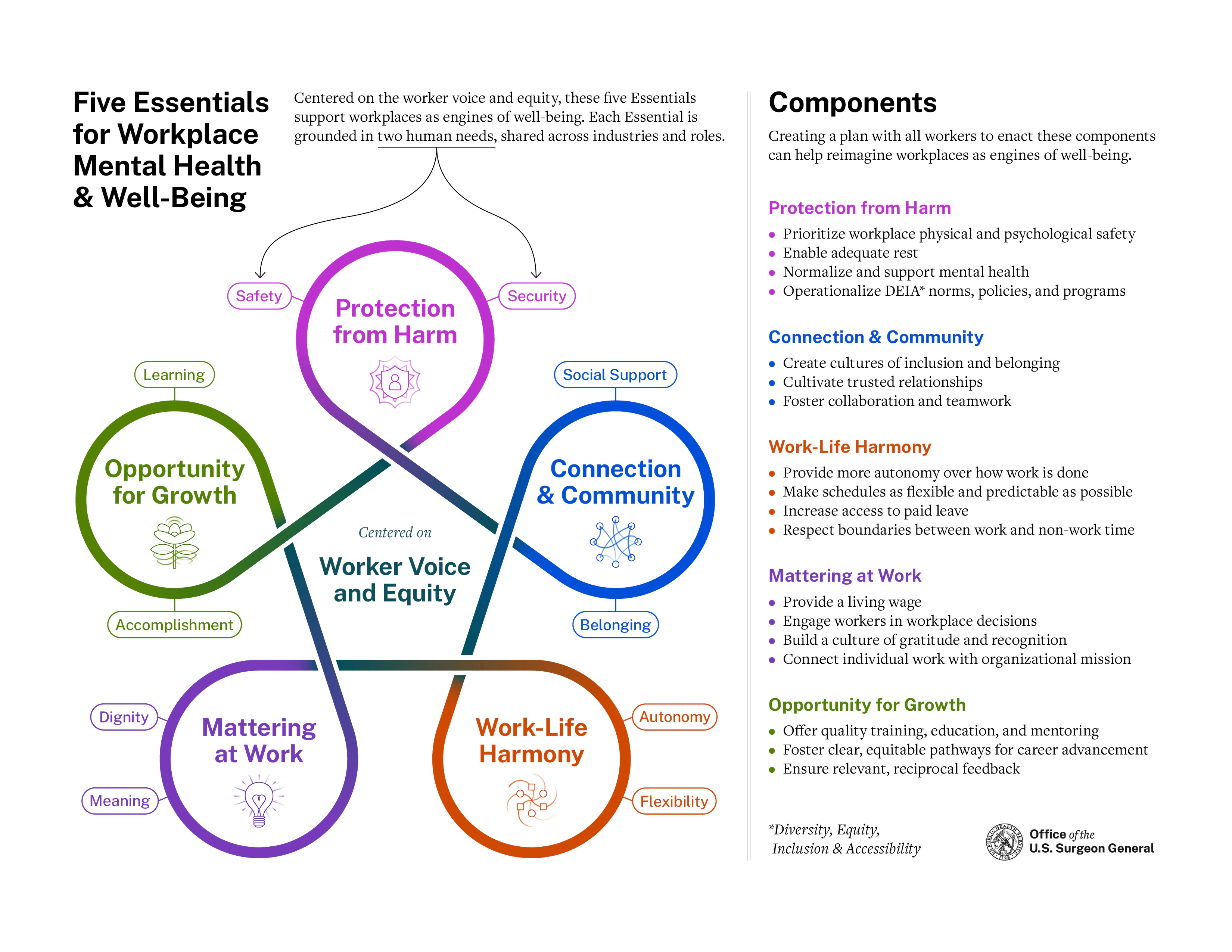
Items are organized by the five domains of the US Surgeon General’s Framework for Workplace Mental Health & Well-Being. Every respondent gets a total score and a domain-specific profile — so a single number never obscures where the strain actually lives.
The scale was tested for psychometric properties (reliability, factor structure, and construct validity) in a series of studies. It’s brief, framework-grounded, and profession-aware — designed to be usable by individuals, teams, or in population-level surveillance.
Interested in using it in your research or organization? Get in touch →
In October 2022, the US Surgeon General released the Framework for Workplace Mental Health & Well-Being — a five-essentials model organized around Worker Voice and Equity. The Augusta+ Scale operationalizes these five domains into a brief, measurable instrument.
Short enough to include in busy workflows or larger surveys without dropping response quality.
Five domains from the Surgeon General’s framework — each scored separately — so a single number reflects the whole picture, not just burnout.
Interpretation bands are calibrated to occupational groups — a physician’s “moderate” isn’t the same as a general worker’s.
Backed by reliability, factor structure, and validity analyses from our foundational study.
If you use the Augusta+ Scale — or want to read the psychometric evidence behind it — please cite the foundational paper first, and any of the follow-up work as appropriate.
MacKinnon, N. J., Ambade, P. N., Hoffman, Z. T., Mehra, K., Ange, B., Ruffa, A., Kornegay, D., & Odo, N. (2024). Development of a New Instrument to Measure Workplace Mental Health and Well-Being. Mayo Clinic Proceedings: Innovations, Quality & Outcomes, 8(6), 507–516. doi:10.1016/j.mayocpiqo.2024.09.002
Ambade, P. N., Hoffman, Z., Yi, M., & MacKinnon, N. J. (2025). A national survey of health professional student preceptors’ workplace mental health and well-being. Electronic Journal of General Medicine, 22(5), em682. view article ↗
MacKinnon, N. J., & Ambade, P. N. (2025). National Academies of Practice’s member survey on workplace mental health and well-being. Journal of Interprofessional Education & Practice. view article ↗
Yes. The survey does not collect your name, email, IP address, or any other identifiable information. Only your anonymized responses to the scale items are recorded, and they are used solely to compute your score and support ongoing psychometric research.
No. The Augusta+ Scale is a research instrument for workplace well-being, not a diagnostic tool. It’s not a substitute for professional help.
Please get in touch. I’m happy to share the validated items, scoring rules, and profession thresholds for academic use.
Yes — the assessment is fully responsive and works on any modern browser.